Sunday, November 4, 2018

Golf course management and the flu shot

So, after being bombarded by healthcare providers, news media, and television advertising, you get a flu shot--and voila, you don't get the flu that winter.  Clearly the vaccination worked, right?  Maybe, but perhaps it wasn't the shot that prevented you from getting the flu but other factors.  There is certainly no guarantee that you would have contracted influenza even without the vaccine, thus a cause and effect relationship would be tough to establish.

What the heck does this have to do with a golf course?  Well, often times we will tweak the turf management program by introducing a new product or practice in hopes of improving turf health.  However, if we apply product "X" to all of the greens and they are in phenomenal condition that year, can we conclude that this product is the greatest thing since sliced bread?  Absolutely not!

Just like your getting the flu shot, if we treat all of the greens, we have no way of truly knowing if the "vaccine" we applied led to improved greens, or it was something else.  In the case of turf, the greatest variable from year to year and month to month is the weather.  There are many, many reasons why grass may lose roots and vigor, most of which are ultimately driven by the weather.

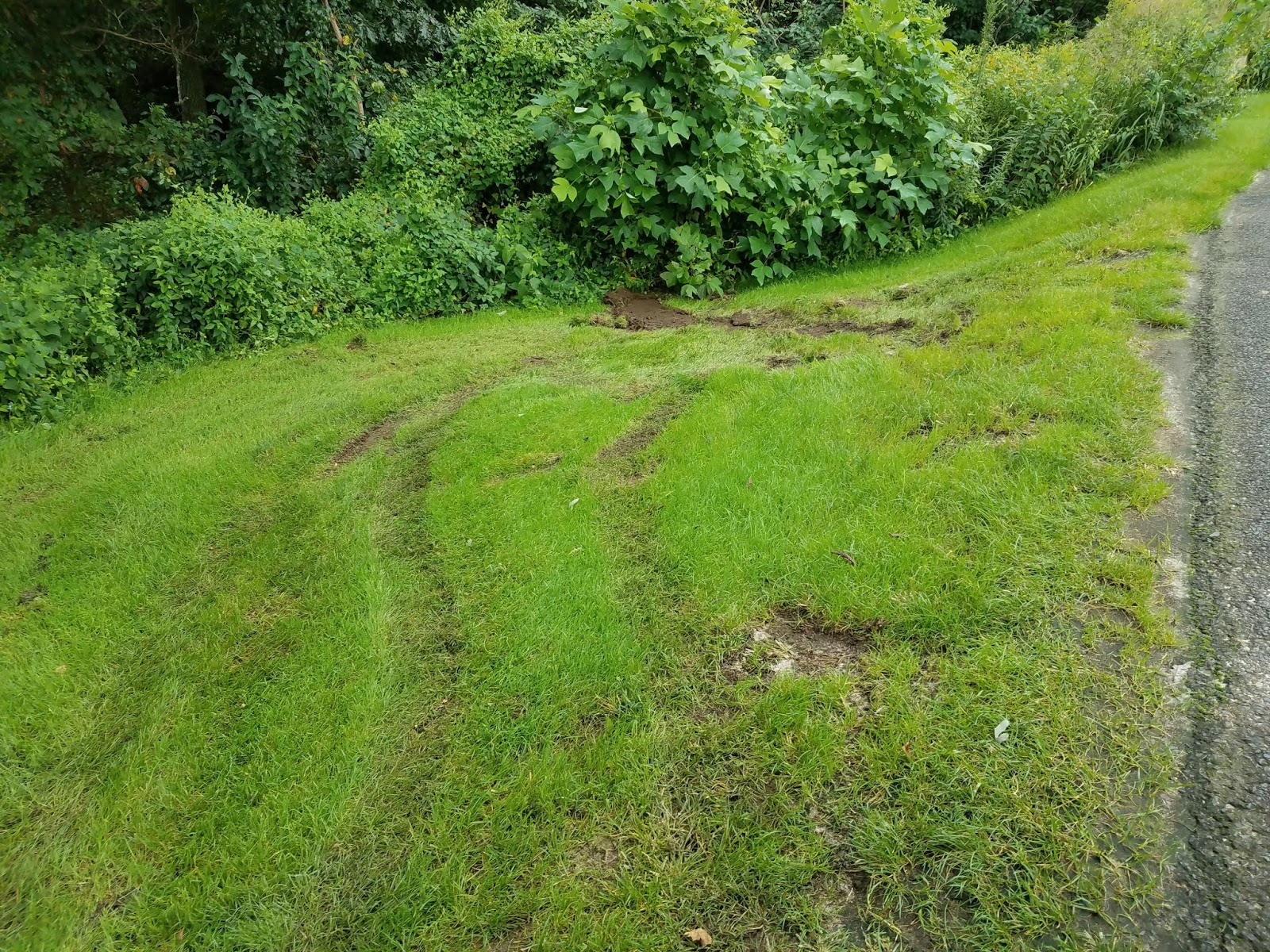
No "flu shot" for the beginning of #12 fairway.

Because of this, it is imperative for us to leave untreated check plots when changes are made to any maintenance practice.  As mentioned last week, we applied the first preventative Take-All patch spray at the end of October, and it won't be until next spring that we see if Take-All develops or not. 
Again, if we spray every fairway this fall, and see no Take-All next year, can we assume the spray worked?  Not really, since weather conditions just might not have been conducive for disease development.  Only by leaving untreated check plots can we begin to draw conclusions.

Lastly, if your doctor recommends getting a flu shot, it's probably a good idea (like having car insurance and hoping you don't need it).  Being an untreated check plot for that miserable virus may not be worth the risk!

Saturday, October 27, 2018

2019 is here

It's officially time to stop whining about this year's weather, and move on.  While we are still focused on providing exceptional playing conditions throughout the fall of 2018, as the golf course mowing requirements start to decrease with cooler temperatures, quite a bit of our efforts are now geared towards having a successful 2019 season.

There is probably no better example of this than our Take-All patch prevention sprays.  The first of these applications was made this past week, on October 26.  Why is this date important?


The significance of spraying for Take-All patch in October, is that the damage from the disease typically isn't seen on the fairways until late spring, often peaking at Memorial Day.  The picture below was taken on May 31, 2018.


So, yes, even as we are still licking our wounds from the summer of 2018, we are actively working to prevent future turf damage from occurring more than half a year from now.

Sunday, October 21, 2018

Rough Recovery

The prolonged hot, wet weather this year took its toll on area golf courses.  In many cases, no part of the course got hit harder than the primary rough.  Both Gray Leaf Spot disease, as well as mechanical injury from carts, maintenance equipment, and even feet, really thinned the turf.  In spots where we can limit traffic, we have aerified and seeded, with promising results.  However, it doesn't look as if we had much time in the "Goldilocks" just right temperature zone for seeding this year.

With nighttime low temperatures of 70 degrees just 10 days ago, we were hoping for some cooler nights to aid in seed establishment and recovery.  Well, once again Mother Nature showed her twisted sense of humor, leaving us with the old "be careful what you wish for" feeling.  This past Thursday night we were in the low 30's, with a solid frost on the golf course.
Seedlings in a primary rough area which was aerified and seeded.

Other areas will be sodded during the late fall and winter, with improved turf varieties that are more traffic tolerant, and disease resistant.  While it's typical for us to sod a few cart path ends in the off-season, it looks like there will be a much greater amount of area that needs to be addressed this year.
The walk-up behind #13 green took a beating this year.

On a positive note, the greens, tees and fairways made it through the year with minimal lasting damage.  With cool nights, the green speed increases as if by magic.  Now all we need is some prolonged dry weather, and you might actually start to get some roll...

Sunday, October 14, 2018

Plenty to do every day...

Unless you happen to live on the golf course--and spend a lot of time looking out your back door--you might think that when the course is closed, little maintenance takes place. In reality, days when we are closed can often be as busy and productive as when we are open for play.

For example, this past Monday, we finally had a chance to lightly topdress the greens, applying an average of 200 pounds of sand per green.  Any practice like this, which may be somewhat disruptive during play, is best accomplished when we are closed.
Scott topdressing #6 green

Additionally, the grass doesn't know if it's a day when the course is open or closed.  Especially this year, with all of the rain, if we have a window of opportunity to mow without causing damage, we need to take advantage of it.   When it comes to the greens, they get their morning mowing seven days per week, whether there is play or not.
Selvin mowing #17 tee

  It now feels like someone finally flicked the switch, and we have been abruptly thrown into fall.  You will hear no complaints about cooler temperatures from the Grounds staff!  However, we can now add one more task to our daily list:  leaf cleanup.
Jim (and a helper) blowing #15 fairway


Sunday, October 7, 2018

Not very low


Ah, October, a month we look forward to, as the heat and humidity of the summer are finally replaced by crisp, cool mornings, and some of the best golfing conditions of the year.  Or, at least that's the way it's supposed to work...

It truly feels as if a book could be written about the weather we've experienced in 2018.  Two weeks ago, the Philadelphia region hit its annual rainfall average--and we've had over 4" of rain since then.  Yes, there definitely have been countless days this year that were neither good for playing golf, nor for maintaining the golf course.

In addition to abundant rainfall, we have also had some crazy temperatures the past several weeks.  However, in this case, we're not talking about extreme daytime high temps, but instead, the nighttime lows.  Going way back to August 27, we have had exactly one single night that hit the average low temperature.  Stop and think about that for a second--that is only one day out of the last 40+ which has been "normal" by this measure.

Through the entire month of September we averaged close to eight degrees above average at night.  The normal low is now 47 degrees, and we have not come close to that.  As you can see below, the lone "cool" night occurred on September 9.


While people may only consider nighttime temperatures when deciding to turn the A/C on or off, if you're a grass plant, what happens at night can be just as important as what happens during the day.  What do these extended warm nights mean for the turf?  Well, with the persistent humidity, moisture, and warm soil temperatures we’ve continued to experience, a lot of the bad actors that have usually packed their bags for the year, are sticking around.

On the turf disease area, we have seen more Gray Leaf Spot in the rough this year than ever before.  With regard to insects, the Annual Bluegrass Weevil is still active, causing damage to some areas of Bentgrass.  And annual weeds have continued to germinate and grow vigorously.

The Annual Bluegrass Weevil has moved on to Creeping Bentgrass.

It used to be that if you made it to August 15 without issues on the course, you were over the hump.  Now, we are into October and still have the fans running around several greens.  We can only hope that it won't be long before we finally see some frost on the pumpkin.

Sunday, September 30, 2018

No Wake...

It is always appreciated when players observe posted signage on the golf course.  For September, we gave up on using "No Carts" signs, and switched to something a bit more appropriate:


Yes, the Philadelphia region reached its average rainfall amount for the entire year a week ago.  Since that mark was hit, we had six straight days with measurable precipitation, totaling an additional 4.3 inches of rain for the week.  And with three months left in 2018, it's hard to know what the year's total will ultimately end up being.
It's been tough keeping up with the rough.
It may be something of an understatement to say the golf course is saturated--if you picture a sponge that can hold no more water, that's right where we are at the moment.  Given the warm temperatures and high humidity throughout the month, the grass keeps growing aggressively, and we have had difficulty finding a window when it's dry enough to mow the turf without causing damage.
Mechanical damage on a slippery slope.
There is an old saying among grass-growers:  The best defense against weed encroachment is a dense stand of turf.  Unfortunately, keeping thick, healthy grass this year has been impossible in many areas.  Both golf carts and maintenance equipment have led to turf thinning, particularly around high traffic pinch points.  Additionally, the region has been clobbered by Gray Leaf Spot, a disease which can quickly damage the Ryegrass in our rough.

Excessive rain and heat led to the breakdown of pre-emergent herbicides earlier in the year, and most courses in the area have dealt with large quantities of Crabgrass and Goosegrass.   Combining the abundance of these plants in the summer of 2018, with the thin turf areas we see now, it seems likely that these opportunistic weeds will be even more troublesome in 2019.

We often say that weather trends tend to even out over the long run.  However, it's now clear that the long run may need to be looked at as a decade or longer, and not a single year.  When we close the books on 2018, by itself, it will certainly not be average in many ways.

Saturday, September 22, 2018

Quadrant I

Those familiar with Stephen Covey's, The 7 Habits of Highly Effective People, will recognize these four quadrants from his time management matrix:

Ideally, with proper planning, we are able to spend most of our time working in Quadrant II, and try to avoid the "putting out fires" of Quadrant I. 

Unfortunately, even with the best planning, there are some events that are difficult to predict.  For example, when we have irrigation issues involving the main line, everything else gets placed on the back burner.  While there hasn't been much need to irrigate lately, having an entire golf hole with no water, is not ideal.

This past Wednesday afternoon, we suddenly had water flowing across the cart path at #5 green.  After doing some exploratory surgery (aka digging), we discovered that the source of this leak was a steel main line fitting on the 6" pipe.

Once the fitting was cut out, it was pretty easy to see what had happened.  These fittings are epoxy-coated during their manufacturing process, however any scratch or scrape of the paint can allow corrosion to develop.  Once a pinhole is formed, the jet of water at 120 psi will quickly cause it to expand.  You can often judge the scale of the irrigation issue by the hole required to make the repair--and this one definitely required the backhoe. 

With four of us spending the better part of the day working on this problem, we were able to get the repair taken care of from start to finish.  (Of course, it may not really be a good thing that we're becoming quite proficient in dealing with main line fitting failures.)  The lesson here is that Quadrant I is not a great place to be spending your time, but if you find yourself there, some Quadrant II pre-planning can be very helpful in extinguishing the fire.