Saturday, August 11, 2018

One in a Million


This past week, Bill Roberson, one of Laurel Creek's original members, and a friend to so many, passed away.

Through business, his love of sports, and his extensive charitable work, Bill knew thousands of people.  But one thing most of these people likely weren't aware of, is that Bill knew way more than your average golfer when it comes to turf management.  Over the last quarter century, I had the privilege to speak with Bill on many subjects.  However, not surprisingly, most of these conversations tied into the golf course in some way. 

I'd like to share a few of my memories about Bill.  I'll preface this by saying that, as a rule, I do not refer to Club members by their first name.  However, I also don't make a habit of addressing friends as "Mr." and I consider Bill Roberson a longtime friend.
  • Seeing how the sausage is made--While many golfers prefer not to encounter the Grounds staff, Bill never minded this--in fact, he seemed to truly enjoy watching the team prepping the course.  Often being in the first group of the day, he would run into the crew, and never once asked them to stop.  Typically, he would say hello, and praise the work that we were doing.
  • An easy choice--When asked a question, Golf Professionals and Golf Course Superintendents won't always come up with the same answer.  However, in 1999, when the Club was first forming a Green Committee, John Tyrell and I were asked independently who we felt would be valuable, contributing members of this Committee.  Without knowing the other's answers, there was one name that we both had on our lists:  Bill Roberson.
  • Life of service--Bill was incredibly generous in many ways, particularly with what may be a person's most valuable commodity--their time.  It would have been easy for him to pay his dues to the Club, and just come here and play.  Instead, he wanted to help.  From the inception of the Green Committee in 1999, Bill has been a member.  2018 marks his 20th year of serving on the Committee.
  • A plant on the Green Committee--Whether it was participating in the golf course Master Plan process, or discussing equipment needs, as a Committee member, Bill was always knowledgeable and engaged, often asking some tough questions.  There were many times when I'd see him on the course, and we'd talk about some current issue in golf course operations.  Odds were good that at the next Committee meeting, without any prompting from me, he would bring up the topic, trying to ensure that others were aware of what we might be dealing with.
  • No payback--Another great thing about Bill was, in the 25 plus years I've known him, I never once received a call, text, or email, asking for something special.  Never the old, "I'm bringing a guest next week, can you give the greens an extra roll that day..."  That wasn't his style.
  • Talking turf--Bill's interest and knowledge of fine turf probably came from a couple of things, one being his leadership role in the LPGA Championship. However, I'm sure the stronger tie he had to my end of the business, was the fact that he has had a Bentgrass putting green at his home since long before we met.  If there's one thing we didn't agree on, it was this green.  I tried for years to convince him to plow it under, and go with a nice artificial green, but he didn't want to hear that.  He enjoyed being able to discuss turf problems--we talked air movement, shade issues, irrigation practices, and turf diseases.  Bill knew that Dollar Spot was largely an annoyance, but Pythium Blight spells disaster.  Undoubtedly, his owning a green helped give him the deep appreciation he showed for the work we do on the golf course.
  • The grass is always greener...or maybe not--Bill played golf all over, including many top 100 courses, but whether it was after a trip to the Monterey Peninsula, or playing someplace closer to home, when he got back, we'd talk about the conditions.  It seems probable that he was showing his bias to his home course, because he'd always tell me that while these other courses were good, they were no better than Laurel Creek.  
  • The joy of giving to others--Besides giving of his time, Bill was generous in other ways, as well.  During his many years of running the McDonald's LPGA Championship tournament, he seemed to truly enjoy having people attend, and treating them like VIPs.  Whether it was heading to DuPont Country Club, or a bit further to Bulle Rock, my family and I always tried to get there for at least one day.  (There was nothing like the McDonald's restaurant on wheels, to get the kids excited about going to a golf tournament.)
  • He made us feel like stars--Bill clearly loved Laurel Creek, the staff, and the golf course.  Over the years, when he had well known public figures as his guests at the Club, he would go out of his way to introduce us to them--but even this was done in a special way.  He lavished praise on the course, to the point that his guests may have felt they should be asking for our autographs, instead of the other way around. 
  • A family man--It was easy to see that Bill cared about family.  Countless times he asked me, "How are the boys doing?"   Many years ago, my family and I went to the Spectrum in Philly to see a show.  As the performance ended, I heard someone calling my name.  I looked around, and saw Bill going out of his way to say hello in the crowd.  I hadn't seen him, and never would have known if he didn't shout to me.  But the fact that he made a special effort to say hello to us, is something I have always remembered.  That's just the kind of man he was.


Thank you for everything you've done for the Club and for me, Bill.  You have always been there, had my back, and listened closely when we talked.  If you've ever got any thoughts or advice about the course, I'll be listening.

Sunday, August 5, 2018

Just an average July...

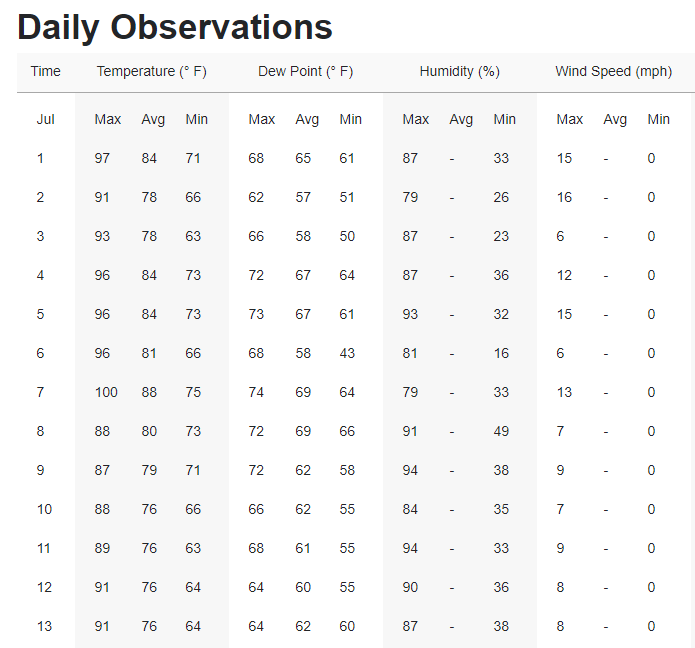
Being the hottest month of the year, when you are growing turf in July, it's never a whole lot of fun.  However, this past month seemed particularly challenging, with hot, dry conditions early, and humid, wet conditions later.

What came as something of a surprise, is that when we closed the books on July, 2018, as a whole, it was pretty darned average.

Yes, below average temps at the end of the month, offset hotter conditions in the beginning, and we finished July less than one half degree above average.  We also ended the month only 5% above average in precipitation.  Golf courses just west of us were not so lucky in the limited rainfall totals.

Another interesting stat is that, even with 16 days in the 90's in the Philadelphia area, as we enter August, we have only had one heat wave this year.  A heat wave is three consecutive days with temperatures in the 90's, so the week straight of 90+ at the end of June and beginning of July still only equaled one heat wave.

Fortunately--sarcasm intended-- it appears that we are now going to get our second official heat wave during early August.  Looking ahead to the middle of this month, with aerification and Master Plan work starting, we really hope that AccuWeather had a glitch on the forecast for the 15th.

One thing is for sure, we won't shed a tear if this is the last heat wave of 2018.  Even the "average" months take their toll.

Sunday, July 29, 2018

Population Shift

Laurel Creek's putting greens are comprised of two very different grasses, Poa annua, and Creeping Bentgrass.  One of the challenges this presents, is trying to insure a smooth putting surface, when the growth habits of Poa and Bent do not coincide.

In our region, Poa can outcompete Bent for most of the year, but then the summer heat comes, and Poa is not a happy camper.  It is always interesting to see how the percentage of these grasses in the greens appears to shift from one season to the next.

As you can see in the picture below, the Bentgrass in the center is coming on strong, while the Poa isn't a fan of July's weather.  There certainly appears to be more Bent than Poa here.

This is quite different than what we see in the spring, where Poa is growing like crazy, and controlling its seedheads is of utmost importance.  An untreated check plot from a seedhead prevention spray shows a whole lot of Poa, and not so much Bentgrass at that time of year.

Below is one final picture which illustrates the competitive edge which Bentgrass has now.  In the areas where we had Fairy Ring hit hard a few weeks ago, it's the Bent that's moving into the ring's perimeter.

We have now past the peak for average summer high temperatures, going from 87 last week, to 86 degrees this week.  While August typically means the shortest roots of the year for cool-season turf, it's good to know that the thermometer should be heading in the right direction, giving both Poa and Bent a much needed break.

Sunday, July 22, 2018

Growing some good weed

Hang on  a second--before anybody gets the wrong idea, we are not talking about a potential new revenue stream for the golf course.  No, in this case, the "weed" we are referring to is milkweed.

The monarch butterfly population has declined dramatically during the past 20 years.  These beautiful insects are dependent on milkweed, and out of play areas on golf courses can provide a great habitat for this plant, and the butterflies.

As a Certified Audubon Cooperative Sanctuary, Laurel Creek is committed to managing the course in an environmentally sensitive manner.  Therefore, when Audubon International established their "Monarchs in the Rough" program, the decision to join was an easy one.  Assistant Superintendent, Don Holgersen, continues to do a great job in keeping us involved in programs such as this.


So, yes, while milkweed may have that four letter word (weed) in its name, it is an important, beneficial plant.  Based on what we are seeing thus far on the course, it's definitely being appreciated by the monarchs!


Sunday, July 15, 2018

Goldilocks Time

If you play the course early in the day, and think the fairways are soft, they very well may be.  When we go through periods that require us to rely exclusively on the irrigation system, moisture uniformity is difficult to achieve, often leaving some areas too firm (aka, dry), and others on the softer side.


There are several factors which contribute to consistent moisture levels--or lack thereof.  For example, the soils on the golf course are quite varied, ranging from fast-draining gravel, to dense clay.  The golf course's topography also leads to exposed mounds drying more quickly than their surrounding swales.  However, probably the single greatest factor impacting moisture uniformity is the irrigation system.

Laurel Creek's irrigation system was designed in the 1980's, and has sprinklers spaced 80' apart.  That is a good chunk of land for a head to cover, and conditions can differ greatly within that area.  Generally speaking, irrigation systems in our region work well to supplement rainfall, not replace it.

In the picture below, you can see some pretty dry turf only 20-30' from the closest sprinkler.


Given the limitations of the system, it will take a full eight hour irrigation cycle to run greens, tees, fairways, and the primary rough for an average of just 15 minutes per sprinkler.  At this time of year, with moisture loss around .25" per day, we are operating in a deficit irrigation mode.  That is, even when running a full cycle, we are not replacing all of the water lost each day.

Where sprinkler coverage is incomplete, portable roller base sprinklers are used to supplement.


Hand watering is another primary way we target specific areas without running the irrigation system excessively.  It is not unusual for us to devote over 1,000 man hours in a season to hand watering.

Without question, water management is one of the most challenging parts of properly maintaining the golf course right now.  Too much water is not good for plant health or playability, and too little water can obviously have its consequences as well.  While this may lead to that Goldilocks feeling (it's too wet here, it's too dry there), the good news is that sooner or later the heat will break and the rain will come.

Sunday, July 8, 2018

It's always something...

As we worked through the heat wave last week, overall, it looked like the course was holding up well.  Of course, that would be the time that some Fairy Ring disease came roaring in on several of the greens.  When Fairy Ring shows up, there is no need for a petri dish and microscope to diagnose the problem, as this fungus is quite easily identifiable.

There can be several visible signs of the fungi at work:  a dark green circle caused by a release of nitrogen in the soil, mushrooms may form on the turf surface, or the fungi may cause the perimeter of the ring to become hydrophobic, causing the turf to wilt. 


Moisture level on the edge of the Fairy Ring.

Significantly higher moisture inside the ring.

A combination of fungicides and wetting agents labeled for the control of this fungus have been applied.  However, these rings are persistent, and with the low fertility regimen we have the greens on, the rings really stand out.  The pictures above were taken the day after treatment, and the "10.3" reading is actually an improvement, and encouraging.

We always try to look ahead, and have an idea of what may be a potential issue.  So, why did the Fairy Ring come as a bit of a surprise?  Well, in looking at our application records, it has been six years since we have had a problem with Fairy Ring.

In trying to better prepare for the future, it would be great to have a solid disease prediction model for Fairy Ring.  One thing that jumps out between the past two times we have seen the disease are temperatures.  When you look at the end of June and beginning of July, 2012, the conditions parallel what we have experienced this year--some really hot, humid weather.  It was the exact same time frame when we last saw Fairy Ring, in 2012.
July, 2012, started out hot!


While it's never fun dealing with these issues, it's somewhat consoling to know we're not in this alone.  A local turf industry consultant recently said that he has seen more Fairy Ring in the past 10 days than in the past three years.  This picture (from a different course) is definitely impressive:

We certainly won't shed a tear if we don't see Fairy Ring again until 2024, and thanks to some experience and solid record-keeping, we should be better prepared when it does arrive.


Sunday, July 1, 2018

Time to play some defense...

For those that grow grass which is cut as low as 1/10", and has to endure a whole lot of traffic daily, we are in the midst of a stretch of nasty weather.  With the exception of the lower practice tee, all of the turf on the golf course is considered to be "cool-season" grass, and the temperatures outside are anything but cool right now.

Up until this point in the season, we have easily been able to push conditions without much concern.  Double mowing greens and rolling several days each week have been standard practice.  However, now it's time to back off--just a bit.  We will continue to mow greens each and every day at the same height of cut, but until the heat breaks, we won't add the additional stress of a second mow, or putting the roller on the greens.  Any mechanical injury caused at this time, will be very difficult for the turf to recover from.

What else do we do when the seven day forecast shows nothing but 90's with some really high humidity?   We definitely apply plant protectants preventatively to the greens, tees, and fairways.  This weather is perfect for some turf diseases like Pythium blight, which can do a whole lot of damage in a hurry.

Another real challenge now is water management on the golf course.  As a whole, we saw quite a bit of rain during the month of June.  However, 85% of that rain came in the first 10 days of the month, and things have been more "miss" than "hit" since then.  When relying on the irrigation system, we don't have the same coverage uniformity that rain provides.  With this really hot and sticky weather, too much water can be worse for the grass than too little water.

It was a cool spring, with many people asking, "When is it going to warm up?"  Hmm, perhaps we should be careful what we wish for!