Saturday, March 19, 2022

Uncovering the tees

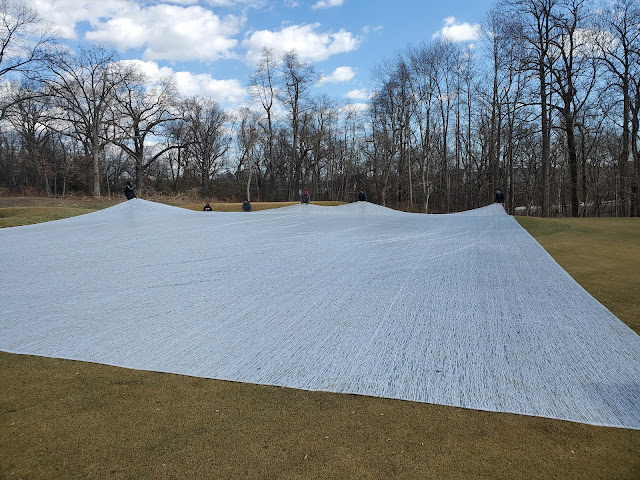
 We removed the covers from the Par 3 tees this past week, and it's pretty clear that the turf enjoyed being in the greenhouse for the winter.


While divots under the cover aren't completely filled in, they are well on their way.  In contrast, divots taken in the uncovered sections are about the same now as they were four months ago.

In looking closely at some of the divots which were protected from the elements, you can see recovery both from the surrounding Bentgrass filling in, as well as from seed which germinated.


March has been unusually warm, so we should have some good growing conditions going forward.

Sunday, March 13, 2022

Mats were undoubtedly successful

 If you had a chance to get out on the course this past week, you may have noticed hundreds of freshly filled divots.  However, while these divots were recently filled with mix, for the most part, they weren't divots that were recently taken.  

No, the vast majority are divots from last October and November which still had yet to fill in.  This speaks to the benefit of using mats on the fairways during the past three plus months.  Had we not, the number of unhealed divots entering the spring would be dramatically higher.  


January was brutally cold, and the Creeping Bentgrass was as dormant as we've seen in years.  When you consider that we have gone close to four months without cutting the fairways, lack of divot recovery shouldn't come as a surprise.  Presently, the fairways are still more straw colored than green.

If you want to see some green grass, you need to check out the short game area greens--they are glowing.


Overwhelmingly, the vast majority of members and guests used the mats as requested during the winter.  With warm temperatures ahead,  everyone will now benefit from this.

Sunday, March 6, 2022

In the shop

While few may see it, winter is one of the busiest times of the year for our Equipment Technician, Don Robel.  All of the equipment is gone over from top to bottom.  Fluids are changed, cables, belts and hydraulic lines are inspected and replaced as needed, and of course, the mowers are sharpened.


This past year has presented its own set of challenges in keeping our equipment fleet up and running.  Similar to the auto industry, there are a handful of parts which are tied up in the supply chain.  And like a car, a triplex mower needs 100% of its parts to work, not just 99% of them.  We have actually had a small part for one of our mowers which has been backordered since late last summer.

Planning ahead is critical to the success of our operation, but between the wild price swings and goods shortages, our planning attempts sometimes feels like we are gazing into a very cloudy crystal ball.

Sunday, February 27, 2022

Two tees--two very different experiences

 Early in January we started the process of releveling #17 Medal tee.  When originally constructed, none of the course's tees had internal drainage, so we decided that while this tee was undergoing some work, we would add drain lines. Quickly the sod from this tee was stripped, stacked and stored.  

However, as soon as the new drain lines were installed, we got heavy rain and the deep freeze of January.  After a fast start, we then went the better part of a month without being able to get a shovel in the ground.  


The sod we had planned on reusing was moved multiple times during this period.  When we were finally able to get back on the tee and finish grading it, the calendar had flipped a page to February, and the decision was made to scrap the heavily divoted sod, and get some new material.  Taking over a month from start to finish on a single tee was frustrating, but in the end we were able to squeeze out a bit more teeing ground for this Par 3.


The next tee the team tackled was the Palmer tee on #16.  In contrast to #17, the weather cooperated.  #16 Palmer was completed in just a couple of days, including the addition of drainage, and we were able to successfully reuse the sod that had been stripped.


The significant difference in the time it took to complete the work on these two tees is just another example of our always needing to roll with the punches, and try to graciously accept whatever weather we have to deal with.


Friday, February 18, 2022

Pulling back the curtain...

 When the ground finally thawed out last week, we took advantage of the opportunity and did a little mid-winter housekeeping on the new short game area greens.  The turf covers were removed, and the greens were mowed.  


This was followed by a fungicide application, then a few hundred pounds of topdressing sand was spread over the surface.  At the end of the day, it was time for the greens to go back to bed--their protective blankets were replaced by the team with speed and efficiency.


It doesn't look like we'll have any extreme weather going forward, so hopefully it won't be another month between mowings.

Saturday, February 12, 2022

Winter Play and Root Shear

 We understand and can relate to the desire to get out on the golf course during some warm(ish) winter days.  However, while it may seem somewhat counterintuitive, there is actually greater risk of causing turf damage now than during periods of extremely cold weather when the soil profile is completely frozen throughout.

In the same way that soil freezes from the top down, so too does it thaw out from the top down.  When this occurs, the moisture on the surface can't infiltrate the frozen soil below, resulting in a mushy top layer, and ice beneath it.  As the pliable surface layer shifts under foot (or cart tire) it can shear away the roots from the solid frozen layer.  From a golfer's perspective, you typically won't see the damage from root shear when it occurs. 

Pockets of snow remained on the course into the weekend.

The USGA has many great educational turf videos, including this short illustration of root shear:

USGA Root Shear

This freezing/thawing cycle can also make evaluating course conditions tricky.  With temperatures dropping below freezing at night, that upper layer often develops a new crust.  The result is that each morning, it may feel as if the course is firm.  But once it warms up during the day, and the surface layer thaws, the afternoon conditions will feel extremely soft again.

Again, we know everyone's itching to get out on the course when there's a beautiful winter day, but it is still February, and we're playing the long game--we want the course in good shape when Opening Day, 2022 arrives!

Tuesday, February 8, 2022

Cabin Fever

 We started the winter by banging out some projects at a quick pace.  However, between snow, ice and frozen soil over the past three weeks, progress has slowed down dramatically.  


Rain at the end of this past week helped to melt away the snow, but with the ground beneath being frozen, the water can't infiltrate.  At the moment, the technical term for golf course conditions is "icky."


One job that can be tackled under most any weather conditions is the perennial pruning of the wetlands crossings.  Our permit for this activity specifically dictates the use of hand tools only, so it's always a good workout for the arms.