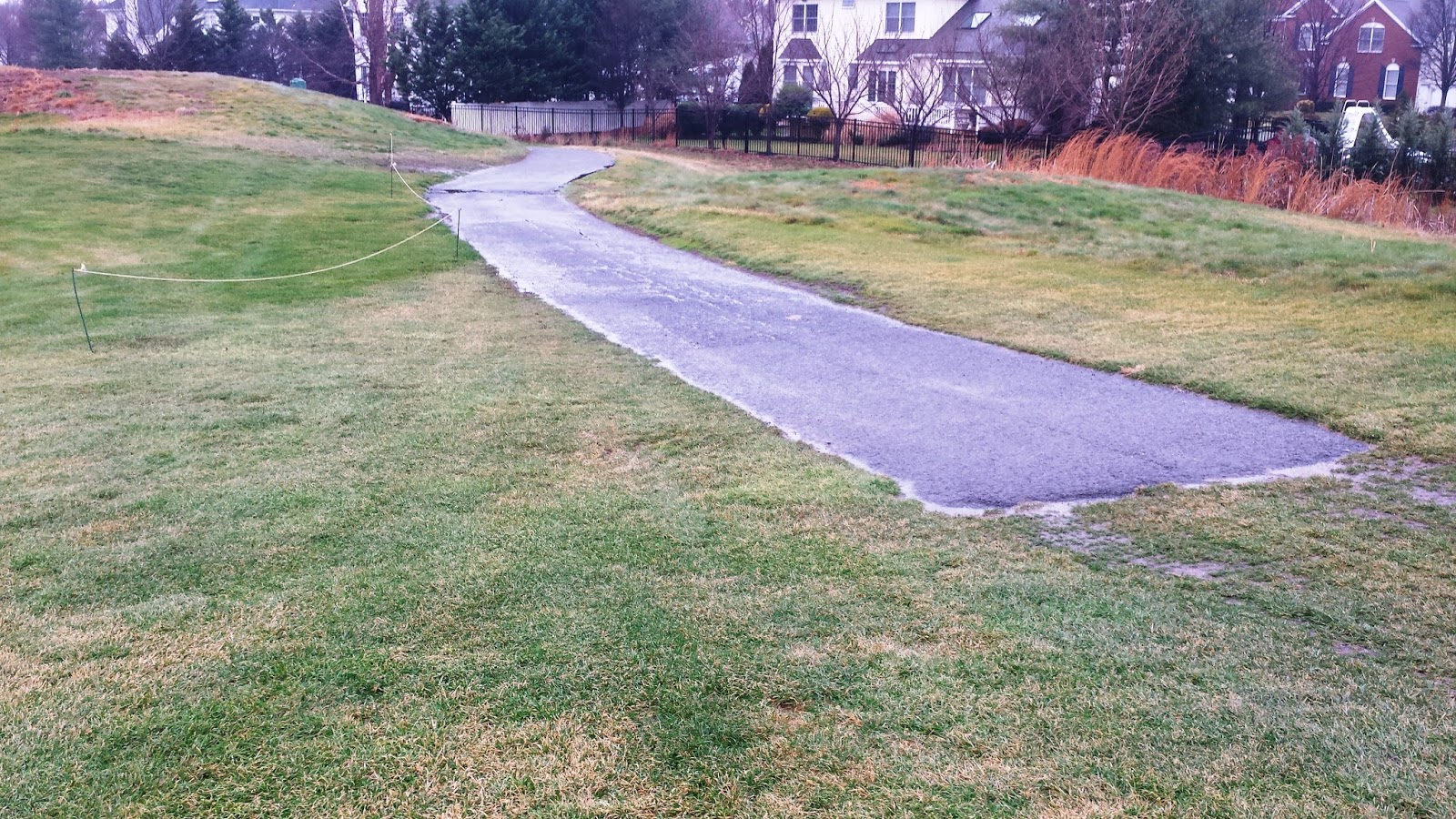
Winter is typically the best time of year for installing drainage on the golf course. However, any area that is in need of drainage is typically quite soft. Therefore we really need some cold weather to firm things up, and the temperatures in the first half of January definitely did not accommodate our needs. Fortunately, the blast of cold air this past week was the perfect thing to provide a slight frost layer in the ground.
The area we chose to attack first was not exactly on the golf course, but on the driving range. Once the new trunk line was established, we used our demolition hammer to break through the storm water basin. This is where the new drain pipe will discharge the water.
Even with frozen conditions we choose to work on plywood since it means there will be no sinking trencher, and leads to an easier cleanup.
With two employees attending Rutgers Turf Program this winter, and others away on vacation, we are working with a light crew. However, while the number of employees may be low, the quality of the employees is high!
Sunday, January 26, 2020
Friday, January 10, 2020
Cautious with carts
If it seems that we are more conservative with allowing carts in the winter than in the spring, summer, or fall, it is not your imagination. This time of year, we definitely must take a more cautious approach with cart traffic than during the rest of the year. Why is this necessary? In large part it comes down to three things: moisture, temperature and recovery.
In contrast to other times of the year, evaporation is much less in the winter. Thus, once soils become wet, they tend to stay that way for a much longer period of time. Not only do we have less water leaving the soil upward, but often times it is also unable to move down.
When the ground freezes beneath the surface, this lower layer will be the last to thaw. So as things begin to melt, the water near the surface is unable to percolate through the frozen layer beneath. This can result in some very soggy conditions on the surface.
The freeze-thaw cycle can also lead to another potential problem for the plant. When the thawing surface has a bit of give or movement to it, but the frozen roots beneath do not, traffic can cause root shear.
As mentioned above, the other part of the equation is turf recovery (or lack thereof). Once we see any damage from cart traffic now, we'll likely be looking at it for quite some time--perhaps for months, as the turf isn't actively growing. The damage may start to snowball as an area that gets traffic and squishes up a bit of mud once, will start to lose its structure and be much more likely to incur further damage next time.
Of course we certainly enjoy seeing some hardy souls on the course during the winter months, and will allow cart use whenever possible, as we keep the long-term condition of the golf course in mind.

In contrast to other times of the year, evaporation is much less in the winter. Thus, once soils become wet, they tend to stay that way for a much longer period of time. Not only do we have less water leaving the soil upward, but often times it is also unable to move down.
When the ground freezes beneath the surface, this lower layer will be the last to thaw. So as things begin to melt, the water near the surface is unable to percolate through the frozen layer beneath. This can result in some very soggy conditions on the surface.
The freeze-thaw cycle can also lead to another potential problem for the plant. When the thawing surface has a bit of give or movement to it, but the frozen roots beneath do not, traffic can cause root shear.
![]() |
| Cart path ends and other "pinch points" can quickly turn to mud with winter cart traffic. |
As mentioned above, the other part of the equation is turf recovery (or lack thereof). Once we see any damage from cart traffic now, we'll likely be looking at it for quite some time--perhaps for months, as the turf isn't actively growing. The damage may start to snowball as an area that gets traffic and squishes up a bit of mud once, will start to lose its structure and be much more likely to incur further damage next time.
Of course we certainly enjoy seeing some hardy souls on the course during the winter months, and will allow cart use whenever possible, as we keep the long-term condition of the golf course in mind.
Sunday, January 5, 2020
Laurel Creek Recognized for Environmental Excellence
We are proud to announce that Laurel Creek Country Club has retained its designation as a "Certified Audubon Cooperative Sanctuary" through the Audubon Cooperative Sanctuary Program for Golf Courses, an Audubon International Program. Assistant Superintendent, Don Holgersen, has led this effort since Laurel Creek was first certified in 2002.
In order to remain certified, we must document our continuing commitment to improving in several areas, including environmental planning, water quality management, and chemical use reduction.
For those who believe that golf courses are harmful to nature, we would point to some telling before and after pictures. Prior to its construction, the majority of the current golf course property was being mined for gravel and clay.
In contrast to this bleak and desolate landscape, as you can see below, today there is an abundance of flora and fauna on the property.
Much of the work we do in wildlife and habitat management takes place behind the scenes. It is therefore very rewarding to have these efforts acknowledged.
In order to remain certified, we must document our continuing commitment to improving in several areas, including environmental planning, water quality management, and chemical use reduction.
For those who believe that golf courses are harmful to nature, we would point to some telling before and after pictures. Prior to its construction, the majority of the current golf course property was being mined for gravel and clay.
In contrast to this bleak and desolate landscape, as you can see below, today there is an abundance of flora and fauna on the property.
Much of the work we do in wildlife and habitat management takes place behind the scenes. It is therefore very rewarding to have these efforts acknowledged.
Sunday, December 29, 2019
The team that gets it done
With the pace of the world today, too often we do not take the time to give thanks for all of the good that surrounds us. Many times, it's only in hindsight that we appreciate those that have made our lives better.
A photo from years ago reminds us of how fortunate we have been to work with such a fine group of individuals.
This picture could be from any time during the past 30 years. The faces might be different, but the goal of providing outstanding playing conditions remains unchanged.
A photo from years ago reminds us of how fortunate we have been to work with such a fine group of individuals.
This picture could be from any time during the past 30 years. The faces might be different, but the goal of providing outstanding playing conditions remains unchanged.
Saturday, December 21, 2019
Onward
While the pace of maintenance activities slows a bit this time of year, the team is still busy preparing for 2020. On the greens, Snow Mold protection has been applied, along with a plant growth regulator to reduce the Poa seeds next spring.
Most areas of the golf course are receiving their Crabgrass pre-emergent herbicide application. Taking care of this now, will allow us to focus on other tasks during the busy upcoming spring.
One of the other jobs we tackle when it's cold is sodding the damaged cart path ends. While there will be little foliar growth during the winter, the sod is able to root without any stress.
As always, we have to work with what Mother Nature gives us. But regardless of the weather or season, there is plenty of work to be done.
Most areas of the golf course are receiving their Crabgrass pre-emergent herbicide application. Taking care of this now, will allow us to focus on other tasks during the busy upcoming spring.
One of the other jobs we tackle when it's cold is sodding the damaged cart path ends. While there will be little foliar growth during the winter, the sod is able to root without any stress.
As always, we have to work with what Mother Nature gives us. But regardless of the weather or season, there is plenty of work to be done.
Sunday, December 8, 2019
Back to the "low maintenance" areas...
As we have the past few years, we are renovating some high profile Fescue areas. This fall, we are addressing the right side of #8, as well as the walk-up area to #15 green.
If you're thinking that this isn't the first time we have worked on the Fescue on #8, you are correct. A few years ago, we amended the heavy topsoil in this area with sand, in order to provide a growing medium which would help produce the thin, wispy stand of grass we were looking for. We followed this up with seeding the area at a very low rate.
The results might best be described as, "be careful what you wish for" since the limited number of Fescue seedlings had trouble competing with the weed population. Because of this, we have switched to using sod when renovating these areas. As we've seen on #7, 13 and 16 the last couple of years, the sod's thatch layer helps to act as something of a barrier for weeds to establish.
The seeding versus sodding of Fescue, points to the challenging balancing act of trying to find that Goldilocks zone of not too thin and not too thick a stand of turf. There is an old saying that a dense, healthy stand of grass is the best protection from weed encroachment. Of course, too thick in the native areas results in lost balls, slow pace of play, and often some sore wrists from trying to hack out of the tall grass.
When it comes to a project like this, even many hands doesn't exactly make "light work" but the team did a great job getting these areas prepped for sod this week!
If you're thinking that this isn't the first time we have worked on the Fescue on #8, you are correct. A few years ago, we amended the heavy topsoil in this area with sand, in order to provide a growing medium which would help produce the thin, wispy stand of grass we were looking for. We followed this up with seeding the area at a very low rate.
The results might best be described as, "be careful what you wish for" since the limited number of Fescue seedlings had trouble competing with the weed population. Because of this, we have switched to using sod when renovating these areas. As we've seen on #7, 13 and 16 the last couple of years, the sod's thatch layer helps to act as something of a barrier for weeds to establish.
The seeding versus sodding of Fescue, points to the challenging balancing act of trying to find that Goldilocks zone of not too thin and not too thick a stand of turf. There is an old saying that a dense, healthy stand of grass is the best protection from weed encroachment. Of course, too thick in the native areas results in lost balls, slow pace of play, and often some sore wrists from trying to hack out of the tall grass.
When it comes to a project like this, even many hands doesn't exactly make "light work" but the team did a great job getting these areas prepped for sod this week!
Sunday, December 1, 2019
Information on Frost Delays
Since you may rarely see it in your own backyard, golfers often underestimate the damage that can occur by walking or driving on frost covered turf. In this brief video, the USGA explains the "how" and "why" of frost damage: Frost Delay--It's Worth The Wait
Despite our best efforts to keep carts corralled during periods of frost, as you can see below, occasionally somebody doesn't get the message.
If you're unsure if there will be a frost delay or not, please check the "Course Conditions" section of the Club's app. We update this each morning to provide you with timely information.
Despite our best efforts to keep carts corralled during periods of frost, as you can see below, occasionally somebody doesn't get the message.
If you're unsure if there will be a frost delay or not, please check the "Course Conditions" section of the Club's app. We update this each morning to provide you with timely information.
Subscribe to:
Posts (Atom)