As most people know, Bermuda grass is considered to be a "warm-season" turf. And while the Bermuda grass on the practice tee was bred and chosen for its tolerance to cold weather, the severe winter weather we experienced two years ago took its toll on both cool and warm-season grasses.
This past spring we re-sodded the back half of the lower practice tee with a newer variety of Bermuda, known as "Latitude 36" which was developed at Oklahoma State University, where the latitude is, yes, 36 degrees N. For reference, Laurel Creek is located at 40 degrees N, with typical winter temperatures just slightly below those at OSU.
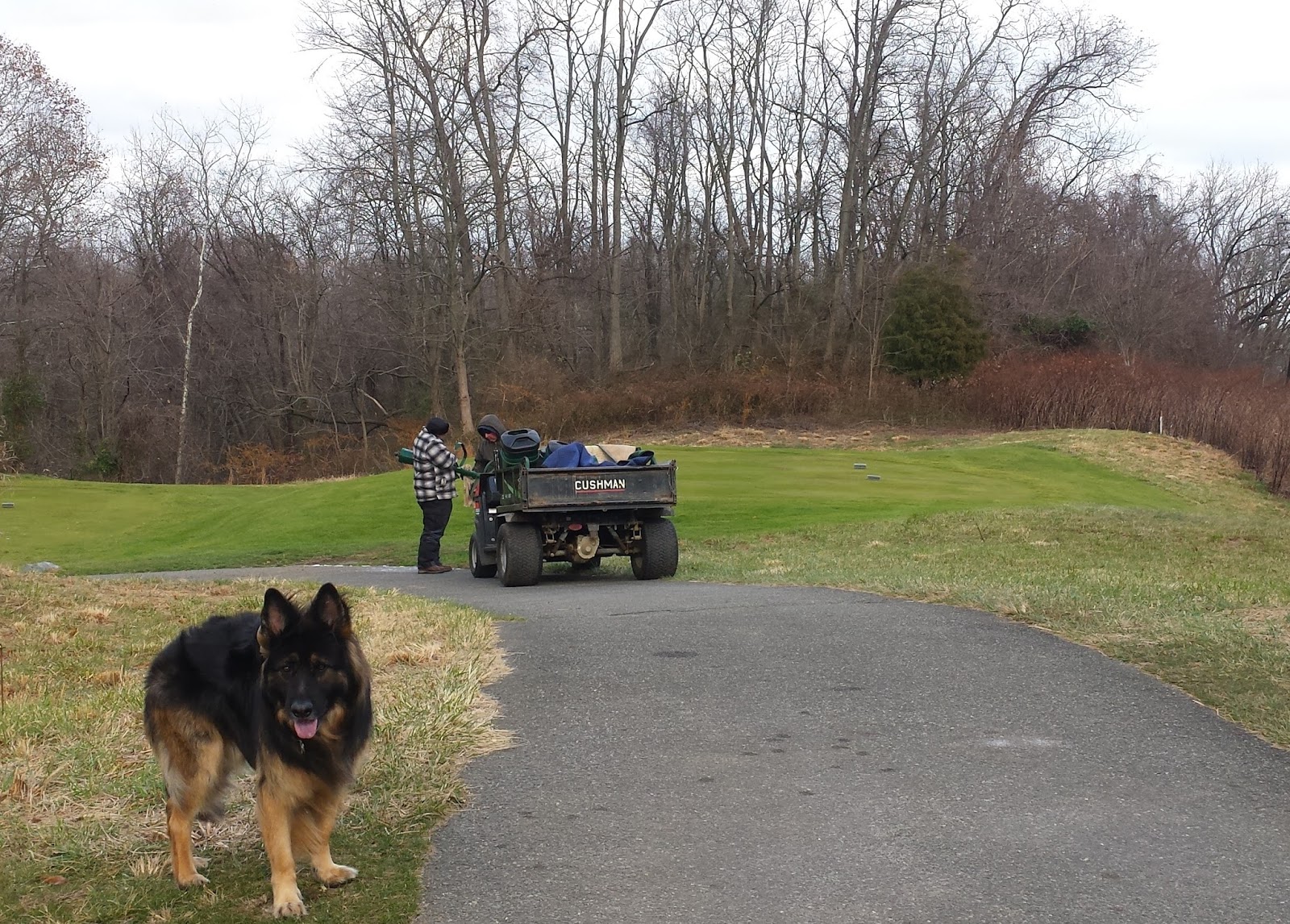
This past week, we covered a good portion of the Bermuda grass on the lower tee to protect it from another potentially nasty winter. We will likely remove the cover in early March when the threat of severe weather has passed.
Whenever we incorporate a new practice into the management of the golf course, we try to leave untreated check plots. In this instance, by covering only a portion of the Bermuda grass, we can better evaluate the benefits of this, and see if it will be worth covering more of the tee in the future.
Given the taste of the Polar Vortex we received this past week, it looks like we may have gotten the cover down just in time.
Sunday, December 18, 2016
Sunday, December 11, 2016
Winter is Coming
After one of the hottest summers on record, and above average temperatures throughout the fall, we finally got a taste of some much cooler weather this past week. While this may give the mowing equipment a break, it definitely doesn't indicate a slow down for work to be done on the course. Here is a sampling of what the crew is working on as winter approaches:
- Bring in course accessories such as water coolers, ball washers and divot mix boxes.
- Repurpose the divot mix boxes with ice melt for the Clubhouse entrances.
- Winterize the irrigation system.
- Bring in the fountain from #5, winterize, and store.
- Pressure wash bridges.
- Leaf removal.
- Prune ornamental grasses.
- Prune red twig dogwoods and oakleaf hydrangeas.
- Pull soil samples for testing.
- Apply pre-emergent herbicide to tees, fairways, and rough.
- Apply Snow Mold prevention to greens.
- Prepare equipment for snow removal.
In addition to these tasks, we've got a few important projects planned for the "off-season" which we will be tackling over the winter. While these may not deliver the visual "wow" of some recent course improvements, it's often the behind the scenes preventive maintenance that keeps things running smoothly when they're pushed to the red line, as the turf was so often this year!
Sunday, December 4, 2016
The Big Blowout
The annual winterizing of the irrigation system surely marks the change of seasons. While we typically blow out the system prior to Thanksgiving, this year we were forced to postpone the event until December.
There were two reasons for this. First, as you have likely seen on the news, we have been way behind in precipitation for several months. Fortunately, we finally got a good soaking rain this past week.
The second thing that made 2016 different from others, was this year's construction project on the golf course, which still had sod being installed well into mid-November. Clearly, keeping sod alive this time of year is a whole lot easier, and requires less water, than when the project started in July. However, once the irrigation system is shut down, we will be relying almost exclusively on rainfall to water this turf.
The golf course itself has over 20 miles of PVC and HDPE piping, so a large compressor is required to get the job of purging water from the system done quickly and efficiently. In addition to this, we also winterize the community entrance islands' systems, the Clubhouse irrigation, the tennis courts, and the Cabana building.
There were two reasons for this. First, as you have likely seen on the news, we have been way behind in precipitation for several months. Fortunately, we finally got a good soaking rain this past week.
The second thing that made 2016 different from others, was this year's construction project on the golf course, which still had sod being installed well into mid-November. Clearly, keeping sod alive this time of year is a whole lot easier, and requires less water, than when the project started in July. However, once the irrigation system is shut down, we will be relying almost exclusively on rainfall to water this turf.
The golf course itself has over 20 miles of PVC and HDPE piping, so a large compressor is required to get the job of purging water from the system done quickly and efficiently. In addition to this, we also winterize the community entrance islands' systems, the Clubhouse irrigation, the tennis courts, and the Cabana building.
Sunday, November 27, 2016
Frost Delays
This time of year, we often have to delay the first start times of the day due to frost. This brief video from the USGA explains why we must avoid both walking and driving on frosted turf:
USGA Frost Delays
While the video discusses the potential for damage to the short grass, even at rough height, cart traffic can severely injure the grass:
As always, our goal is to provide the best playing conditions for you. Protecting the health of the turf is obviously important in achieving this, and your patience is appreciated.
USGA Frost Delays
While the video discusses the potential for damage to the short grass, even at rough height, cart traffic can severely injure the grass:
As always, our goal is to provide the best playing conditions for you. Protecting the health of the turf is obviously important in achieving this, and your patience is appreciated.
Sunday, November 20, 2016
Giving Thanks
While there's no such thing as an easy year on the golf course, 2016 will certainly be remembered as a more challenging one. Mother Nature threw it all at us this year--from extreme heat and limited rainfall, to weed, insect, and disease activity, the likes of which we've never seen. Add to this a construction project which started in July, and 2016 won't be forgotten anytime soon.
With cooler temperatures now, we can take the opportunity to step back and reflect on what areas of the operation worked well this year, and where changes can be made going forward. One thing that is abundantly clear is that we couldn't have succeeded without the support and hard work of those on the front line each and every day.
These guys take great pride in their work, and appreciate being able to enhance our members' golfing experience. So, at this time of year, when we are grateful for so many things in our lives, we thank the team who worked tirelessly to make 2016 a successful year on the golf course.
With cooler temperatures now, we can take the opportunity to step back and reflect on what areas of the operation worked well this year, and where changes can be made going forward. One thing that is abundantly clear is that we couldn't have succeeded without the support and hard work of those on the front line each and every day.
These guys take great pride in their work, and appreciate being able to enhance our members' golfing experience. So, at this time of year, when we are grateful for so many things in our lives, we thank the team who worked tirelessly to make 2016 a successful year on the golf course.
Sunday, November 13, 2016
Ripping the Rough
As we've said many times, we love all of the wildlife the golf course is home to. However, over the past couple of months, we continue to see areas of the rough where digging is taking place.
In late September or early October, it seemed that this might be the work of skunks or raccoons going after grubs, yet the ripping of rough continues even now. Well, we finally saw who is actually responsible for this damage:
Perhaps someone might want to remind these vandals that we're only a little over a week away from Thanksgiving!
In late September or early October, it seemed that this might be the work of skunks or raccoons going after grubs, yet the ripping of rough continues even now. Well, we finally saw who is actually responsible for this damage:
Perhaps someone might want to remind these vandals that we're only a little over a week away from Thanksgiving!
Sunday, November 6, 2016
Soil or dirt?
What's the difference between soil and dirt? Soil is what you grow crops in, while dirt is what you get under your fingernails.
This may be a somewhat lighthearted answer to this question, however, when we stick a shovel in the ground of the golf course, we are quickly reminded of what much of the property used to be--a quarry. Often times, we find that we're growing turf on something that many people would refer to as dirt, not soil. The picture below of an old clay pit on site shows the very sandy material on top of an incredibly impermeable clay.
With over one million cubic yards of material moved during the original construction of the golf course, what's beneath the surface often resembles a marble cake, as these two different soils were used as fill material.
These days, what's under the ground may not be seen very often, but this fall's construction brought the issue back to the forefront of our thoughts. Once again, you can clearly see why some areas never seem to dry out, and others are always droughty.
Upon closer inspection, both of these "soils" look like they might have come from somewhere other than Earth.
Certainly neither of these resemble a potting soil or bagged topsoil that you'll find in the nursery section of the local home improvement store. So what might be dirt by some folks' standards, is soil for us. Of course, if Matt Damon can grow crops with this stuff, who are we to complain:
This may be a somewhat lighthearted answer to this question, however, when we stick a shovel in the ground of the golf course, we are quickly reminded of what much of the property used to be--a quarry. Often times, we find that we're growing turf on something that many people would refer to as dirt, not soil. The picture below of an old clay pit on site shows the very sandy material on top of an incredibly impermeable clay.
| The natural stratification of soils can easily be seen in the old quarry. |
With over one million cubic yards of material moved during the original construction of the golf course, what's beneath the surface often resembles a marble cake, as these two different soils were used as fill material.
These days, what's under the ground may not be seen very often, but this fall's construction brought the issue back to the forefront of our thoughts. Once again, you can clearly see why some areas never seem to dry out, and others are always droughty.
![]() |
| Drain line crossing #1 fairway. |
![]() |
| Bunker drainage on #16. |
![]() |
| "Moon pottery" from #1 on the left and "Martian coffee grounds" from #16 on the right. |
Subscribe to:
Posts (Atom)