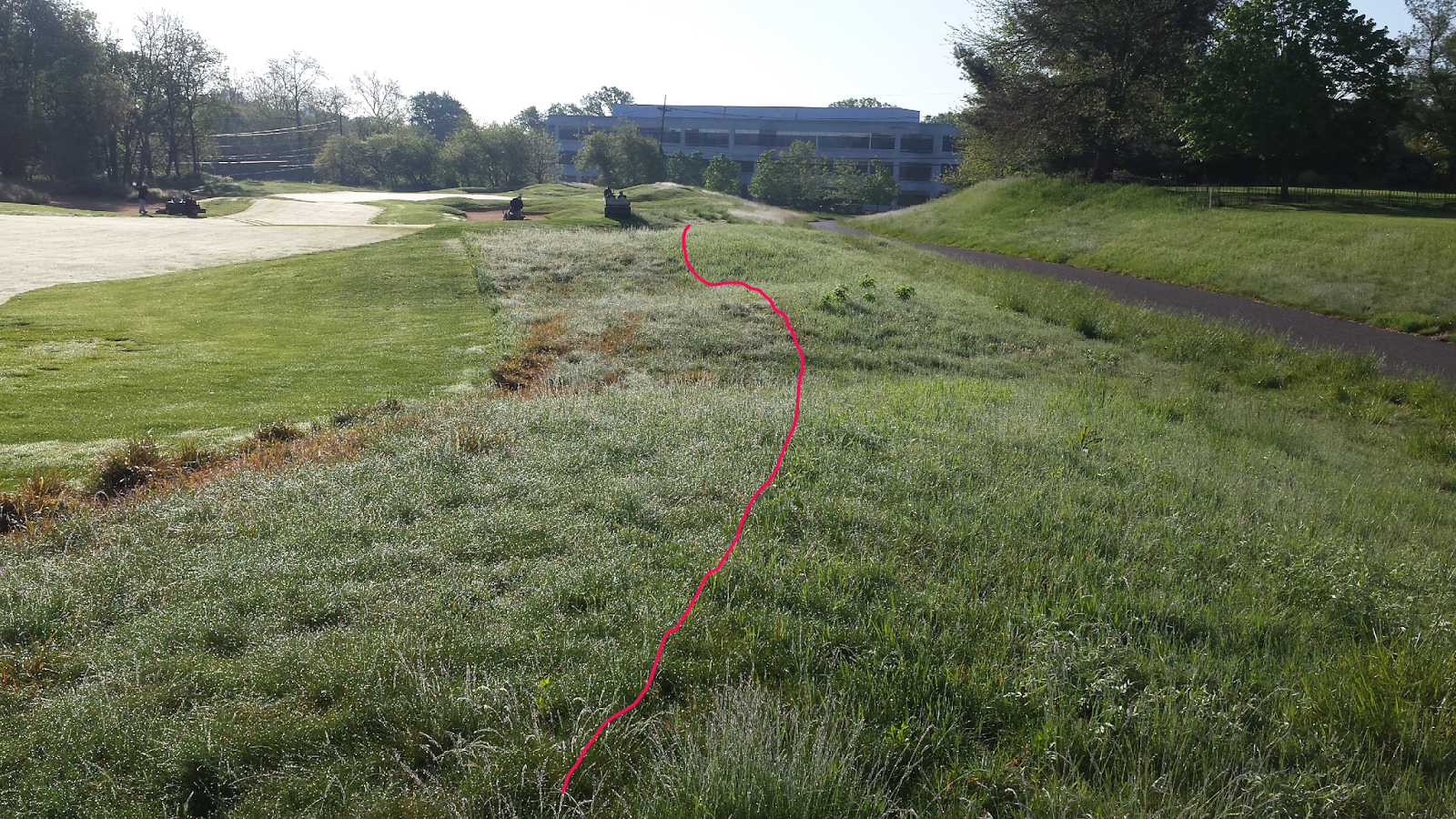
*Doesn't every day of the year have 24 hours?
Sunday, June 26, 2016
Longing for Light
As we've mentioned before, morning sunlight is of utmost importance when trying to grow healthy turf. The picture below was taken at 9:00 AM, on June 21, the first full day of summer. Looks like even during the "longest day of the year,"* #18 faces some challenges.
Sunday, June 19, 2016
Better Bermuda
As you may have noticed, we stripped a portion of the lower practice tee two weeks ago, and sodded with Bermudagrass.
The winter of 2014-2015 took its toll on the original Bermudagrass, and while the tees made it through last summer in decent shape, we felt it best to have a clean stand of this heat-loving turf in place for the summer of 2016.
With only having the range closed for one day, the team kicked it into high gear for this project. The old sod was stripped, hauled away, the tee surface aerified, raked smoothed, and the new sod was installed--all in under eight hours.
Even before the Sun hits it, the new Bermudagrass on the back of the tee is looking good, and will be ready for use within a week.
The winter of 2014-2015 took its toll on the original Bermudagrass, and while the tees made it through last summer in decent shape, we felt it best to have a clean stand of this heat-loving turf in place for the summer of 2016.
![]() |
| It's out with the old, as we start to strip and remove the sod on the lower tee. |
Even before the Sun hits it, the new Bermudagrass on the back of the tee is looking good, and will be ready for use within a week.
Sunday, June 12, 2016
Putting Weevils to Work
As we've said before, over the past several years, the Annual Bluegrass Weevil has become one of the most troublesome pests on the golf course. Given the high percentage of Annual Bluegrass (Poa) in the greens, we have to remain ever vigilant to guard against damage from weevils on the putting surfaces.
However, as most of the tees and fairways still have very little Poa, we see this as a potential opportunity to get some biological control by allowing them to kill the small amount of Poa.
Even though Poa is much more susceptible to damage from this insect, Bentgrass can also be damaged by weevils during the stress of the summer, and when weevil populations become high. So, we will allow them to work on the Poa now, then use control measures to knock back the weevil populations in the Bentgrass beginning in July.
However, as most of the tees and fairways still have very little Poa, we see this as a potential opportunity to get some biological control by allowing them to kill the small amount of Poa.
![]() |
| Weevils have been munching on the Poa on #17 tee. |
Even though Poa is much more susceptible to damage from this insect, Bentgrass can also be damaged by weevils during the stress of the summer, and when weevil populations become high. So, we will allow them to work on the Poa now, then use control measures to knock back the weevil populations in the Bentgrass beginning in July.
Sunday, June 5, 2016
Golf and the Environment
There was a great article about Laurel Creek in the Sunday, May 29, Burlington County Times. This feature piece gave insight into the Club's environmental efforts, and the requirements to maintain our certification as part of the Audubon Cooperative Sanctuary Program for golf courses.
Once again this year, Assistant Superintendent, Don Holgersen, led this project, with the help of Assistant, Mike Crane.
A video made by the Times can be viewed here:
Nature is Par for the Course
Once again this year, Assistant Superintendent, Don Holgersen, led this project, with the help of Assistant, Mike Crane.
A video made by the Times can be viewed here:
Nature is Par for the Course
Sunday, May 29, 2016
Take-All Patch
We've all heard the oft-quoted phrase, stating that insanity is doing the same thing over and over again and expecting different results. Well, not to argue with Mr. Einstein, but when it comes to growing turf, we can do the same things year after year, and never see the same results twice. Clearly, the variable is the weather, and it seems to have thrown us a curve ball once again.
If you notice brown areas of turf on some tees and fairways, you're most likely seeing the record amount of Take-All Patch we're dealing with. Each and every year, we have seen some of this disease, however never to this extent.
As with most turf diseases, Take-All is active in a relatively narrow temperature range. In a typical spring (if there is such a thing), the symptoms of this disease appear on the foliage as a slightly weakened looking stand of turf, but as the soil temperatures increase, the disease activity stops, and the Bentgrass grows out of it. However, this spring's prolonged cool weather appears to have kept things in the "sweet spot" for this pathogen.
When you compare May, 2016 to May, 2015, you can see how soil temperatures remained much cooler throughout the first three weeks of the month, often hovering in the 55+/- degree range where Take-All is active.
While this may have been a weather anomaly, which may not occur again for years, steps are being taken to ensure that we won't see the same issue again, regardless of the spring weather. We are fortunate to have a great local support network of turfgrass disease experts to consult with, including Rich Buckley, Director of Rutgers Plant Diagnostic Lab, Steve McDonald of Turfgrass Disease Solutions, and Adam Moeller, USGA agronomist.
With a root-borne pathogen such as Take-All, prevention is key, as we only see declining leaf tissue after the damage is already done to the root system. The plan going forward will likely include preventative fungicide treatments in the fall, as well as an increased use of acidifying nitrogen sources, such as ammonium sulfate, which will lower the soil pH, decreasing the severity of Take-All.
If you notice brown areas of turf on some tees and fairways, you're most likely seeing the record amount of Take-All Patch we're dealing with. Each and every year, we have seen some of this disease, however never to this extent.
As with most turf diseases, Take-All is active in a relatively narrow temperature range. In a typical spring (if there is such a thing), the symptoms of this disease appear on the foliage as a slightly weakened looking stand of turf, but as the soil temperatures increase, the disease activity stops, and the Bentgrass grows out of it. However, this spring's prolonged cool weather appears to have kept things in the "sweet spot" for this pathogen.
![]() |
| Take-All on #12 fairway. |
When you compare May, 2016 to May, 2015, you can see how soil temperatures remained much cooler throughout the first three weeks of the month, often hovering in the 55+/- degree range where Take-All is active.
While this may have been a weather anomaly, which may not occur again for years, steps are being taken to ensure that we won't see the same issue again, regardless of the spring weather. We are fortunate to have a great local support network of turfgrass disease experts to consult with, including Rich Buckley, Director of Rutgers Plant Diagnostic Lab, Steve McDonald of Turfgrass Disease Solutions, and Adam Moeller, USGA agronomist.
With a root-borne pathogen such as Take-All, prevention is key, as we only see declining leaf tissue after the damage is already done to the root system. The plan going forward will likely include preventative fungicide treatments in the fall, as well as an increased use of acidifying nitrogen sources, such as ammonium sulfate, which will lower the soil pH, decreasing the severity of Take-All.

Sunday, May 22, 2016
Finer Fescue
We've already received some positive comments regarding the playability of the Fescue. For the second year, we added a spring mowing to these areas, which will help to set us up well as we enter the summer. Mowing helps thin the stand and allows us to address weed issues early.
Use of selective herbicides in these areas has also been increased. One product in particular is doing an outstanding job of removing undesirable grasses, while leaving the fine Fescues untouched. After the first application of this product along the right of #16, there was quite a contrast between the treated and untreated areas.
If used carefully, this selective herbicide can make a dense, unplayable area a bit more friendly.
Use of selective herbicides in these areas has also been increased. One product in particular is doing an outstanding job of removing undesirable grasses, while leaving the fine Fescues untouched. After the first application of this product along the right of #16, there was quite a contrast between the treated and untreated areas.
![]() |
| Treated portion to the left, and untreated to the right. |
![]() |
| A treated area to the right of #10 green. |
Sunday, May 15, 2016
The One-Two Punch
The aerification process is always evolving, based on the particular need we are addressing. You might wonder why the greens need a different aerification plan now than in the past. Well, the greens are over 25 years old, and in much the same way that the needs change for a person to remain healthy as they age, so too do the needs of a putting green.
Aerification helps remove excess organic matter when a plug is pulled, and helps dilute the existing soil profile when sand is used to fill the hole. Traditional hollow tine aerifiers pull a plug 3-4" in length. This also happens to be the approximate depth of sand and organic matter which has accumulated during the life of the greens. Thus, we are finding that we are reaching the limit of a traditional aerifier being able to break through the built up material, and create a channel to the mix below.
What's the answer to this? We decided to go with the one-two punch again this spring. On Monday, we aerified the greens with 7/16" hollow tines on a very tight spacing. The plugs were removed (organic matter reduction) and the holes filled with sand.
Phase two occurred the next day when we had an outside contractor come to the course with some unique aerifiers, called Dryject. These machines use high pressure water to create a small hole on the surface, and sand is instantly vacuumed into this. The company set the machines to the 4-6" depth we were looking for.
As you can see in the picture, the Dryject was able to get more sand, deeper into the soil profile when compared to a traditional core aerifier.
Between the two processes, we used 90 tons of sand on the greens! Players sometimes ask us why we need to aerfiy the greens when they are in great shape. The answer is that it is this kind of on-going cultural practices which allow us to have great greens throughout the year.
A comparison could be made to a car: Why take it in for maintenance when it's running fine? Because it's that maintenance that keep your vehicle running well. This combination of aerification practices provides the benefits that will help the greens make it through this summer's heat.
Aerification helps remove excess organic matter when a plug is pulled, and helps dilute the existing soil profile when sand is used to fill the hole. Traditional hollow tine aerifiers pull a plug 3-4" in length. This also happens to be the approximate depth of sand and organic matter which has accumulated during the life of the greens. Thus, we are finding that we are reaching the limit of a traditional aerifier being able to break through the built up material, and create a channel to the mix below.
What's the answer to this? We decided to go with the one-two punch again this spring. On Monday, we aerified the greens with 7/16" hollow tines on a very tight spacing. The plugs were removed (organic matter reduction) and the holes filled with sand.
Phase two occurred the next day when we had an outside contractor come to the course with some unique aerifiers, called Dryject. These machines use high pressure water to create a small hole on the surface, and sand is instantly vacuumed into this. The company set the machines to the 4-6" depth we were looking for.
As you can see in the picture, the Dryject was able to get more sand, deeper into the soil profile when compared to a traditional core aerifier.
Between the two processes, we used 90 tons of sand on the greens! Players sometimes ask us why we need to aerfiy the greens when they are in great shape. The answer is that it is this kind of on-going cultural practices which allow us to have great greens throughout the year.
A comparison could be made to a car: Why take it in for maintenance when it's running fine? Because it's that maintenance that keep your vehicle running well. This combination of aerification practices provides the benefits that will help the greens make it through this summer's heat.
Subscribe to:
Posts (Atom)