Monday, September 7, 2015

Still Hot and Dry

The timing of our late summer aerification typically coincides with a shift in the weather, going from hot, dry summertime conditions, to cooler temperatures and beneficial rainfall.  Clearly, somebody forgot to make Mother Nature aware of this, as she has yet to turn the page.

We have always said that it takes one good rainfall to help the course completely heal from aerification.  Unfortunately, that didn't happen this year.  As of last Wednesday, we were over 3.5" behind in precipitation for the past 60 days.  Given this lack of rain, we have relied almost exclusively on the irrigation system to provide the water the "patient" requires following major surgery.  Over 800 man hours have been dedicated to hand watering fairways this season, as a supplement to the irrigation system sprinklers.  Yet, with no rain, it's been a battle trying to maintain moisture at a uniform level, which will help the turf recover most quickly.
An unirrigated section of the course.

The second blow from this one-two punch has been the excessive heat.  Last week, we enjoyed heat wave number five, and this week we may be dealing with number six.  For the first time in 42 years, September started with four days in the 90s.  Again, this has proved to slow recovery from aerification and lead us to irrigate more than we typically would under normal growing conditions this time of year.
Our on site weather station's recording last Wednesday.

With cooler temperatures and timely rainfall, late summer and early fall often allow us to provide some of the best playing conditions of the year--firm and fast.  Undoubtedly, we will get there...just not as quickly as we'd like.

Friday, August 28, 2015

Only at a Major

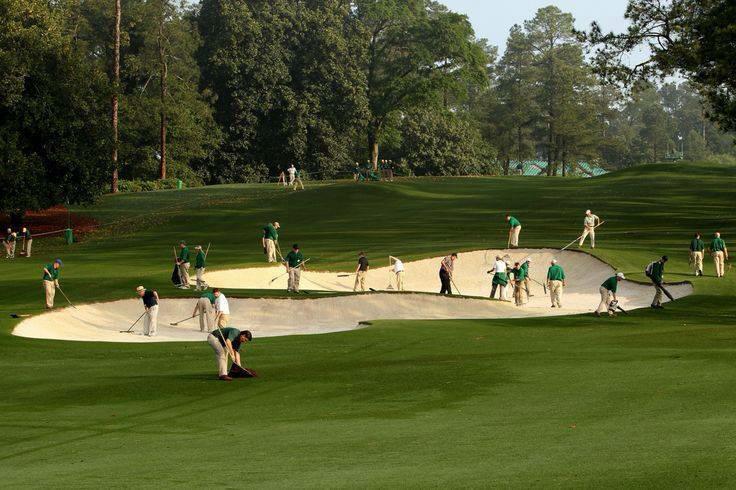
The behind the scenes work for one of golf's major championships never ceases to amaze.  There are more individuals working in and around this one bunker than most golf courses have on their entire greens staff:

And while this may look like a time lapse of a single mower at the US Open, it is not.  Fairways get cut pretty quickly when you send out 17 mowers at once:

Saturday, August 15, 2015

Ready to Roll

After aerifying the greens on Monday, we applied over 75 tons of sand to fill the holes.  With all of this sand, we typically aren't able to mow the greens for a few days.  However, we will begin rolling them the day after we aerify. 

In the past, this rolling ahead of golfers could be a messy experience, as the sand would stick to the roller, then drop off leaving clumps across the green.  We'd often have to have two employees follow the roller using dew whips or blowers to disperse the sand.

A less messy alternative is waiting until the greens are completely dry to roll them.  However, if there's a heavy dew, that can mean not starting to roll until 10:00 in the morning, causing us to interfere with play.

Fortunately, several years ago, we found a solution to this issue.  We head out with the roller first thing in the morning, but run the green sprinklers for three minutes (or one spin), just ahead of the roller.  You might expect that adding moisture to the surface would lead to more sand sticking, but it actually does the opposite.  If we time it right, and start rolling as soon as the heads drop, there is virtually no sand pick up and no clumps to deal with.
The roller is waiting for the sprinklers to shut down.

Saturday, August 8, 2015

Sometimes softer in summer?

It may seem counterintuitive that golf course conditions may not be as firm during periods of hot, dry summer weather, as they are during cooler periods when we receive more consistent rainfall.  However, there are several reasons why this may occur, most of which involve the irrigation system, and the frequency and scheduling of irrigation cycles:

  • Let's start with the irrigation system itself.  Our system was designed in the 1980s and doesn't provide the uniformity of coverage of a more modern design.  Despite having employees spend up to 500 man hours per month hand watering to supplement coverage deficiencies, we still can't provide the uniformity of rainfall.  Thus, at times, it feels like Goldilocks--this area is too wet, this area is too dry, this area is just right.
  • Given the hit or miss nature of rain events in the summer, there are occasionally times when we schedule an irrigation cycle, not willing to take the risk that we "might" get a shower or thunderstorm.  For example, last Friday was forecast to be a washout with temperatures staying in the 70s...then they called for showers...followed by a change to rain from the city south.  And how did the day actually turnout?  Brilliant sunshine and low humidity with a high of 85.  A day that was expected to add moisture to the soil profile, instead ended up lowering moisture levels.  We are fortunate to have an on-site weather station and the ability to remotely initiate or suspend irrigation cycles, but it's easy to feel like you need a crystal ball to accurately know the upcoming weather and schedule the irrigation accordingly.
Friday's weather surprised many.

  • With cool season turf, the longest root system of the year is in the spring.  With less stressful environmental conditions, and plenty of roots to bring moisture and nutrients into the plant, going long periods between rain or irrigation isn't a problem at that time of year.  However, as you can see below, in August, cool season grass has the shortest roots of the entire year.  In the case of Poa greens the "functional root sytem" this time of year may be less than one inch in length.  Allowing the soil to dry beyond a point where the roots can access moisture, can quickly spell trouble.
The shortest roots of the year are in August.
  • The greens are designed to drain well, and the Dryject treatment they received in the spring has increased the water infiltration rate.  The data for the graph below comes from one of the sensors buried in #1 green.  The spike in moisture seen in the orange line was caused by a fairly significant rain event of .70".  However, within 24 hours after the rain, moisture levels at a 2" and 7" depth in the green are very close to the pre-rain numbers.  In this situation, the rain didn't provide a reservoir of moisture which the turf can draw from for several days, and irrigation may be required.   

  • Finally, as we enter August and get ready for aerification, we need to be sure we have good, uniform soil moisture.  Similar to surgery on a person, aerifying has long-term health benefits for the turf, but it also causes some temporary stress.  We need to have a healthy "patient" in order to minimize the risk of post-surgical complications (like wilt), and help speed recovery.
Soon enough, fall will be here, a season which often leads to some of the best playing conditions of the year.
 

Monday, August 3, 2015

Time to Tine

We will begin aerification next Monday, and are hoping that things cool off a bit so we can get the greens aerified first, followed by tees and fairways. 

While aerification most certainly has long-term health benefits for the plant, the process of coring, dragging, topdressing, and working the sand into the holes of the green can be stressful.  Fortunately, the long-range forecast looks like we'll break this extended heat wave and get back to some temperatures which are more tolerable for both humans and turf.

Monday, July 27, 2015

One Step at a Time

New steps, which match the retaining wall, are going to be installed from the upper practice tee to the lower tee. 
The installation of these steps will begin next week and may take the contractor a few days to complete.  Therefore, we removed one set of wooden steps, giving the contractor a place to start.  Once they are completed and put into service, we will remove the second set of wooden steps.

Friday, July 17, 2015

A Great Team

Every year it can be a challenge to fill the ranks of our course care team.  We have been very fortunate this year to have a great group of guys who are hard-working, conscientious, and strive to produce outstanding playing conditions for you every day.

Often they work behind the scenes, however if you happen to run into any of the crew, feel free to give them a thumbs up for their hard work.
Prepping #7 green for the Men's Club Championship.